Reverend Joseph Cartwright Sr.
Early Life
Reverend Joseph Cartwright Sr. was born on July 13, 1783 in Virginia to father Hamilton Cartwright, aged 28, and an unknown mother. He was born enslaved, possibly to the Rose family, and labored on their plantation in Leesburg, Loudon County, Virginia. Joseph Cartwright and Susanah (Sucky) Wilson, a fellow enslaved laborer, were married on December 16 or 26, 1800, in Maryland, likely near Georgetown. Over the span of the next twenty-two years, they had ten children—Alfred, Charles, Hamilton, Joseph W., Lewis Sr., Nora Ann, Mary Sophia, Phoebe, William, and Wilson—all of whom were born into bondage. On December 5, 1850 Susanah Wilson passed and was buried in the Mount Zion Cemetery in Georgetown D.C. On December 2, 1851 Reverend Joseph Cartwright passed away at age 68 and was buried alongside his late wife in the Female Band Union Cemetery.
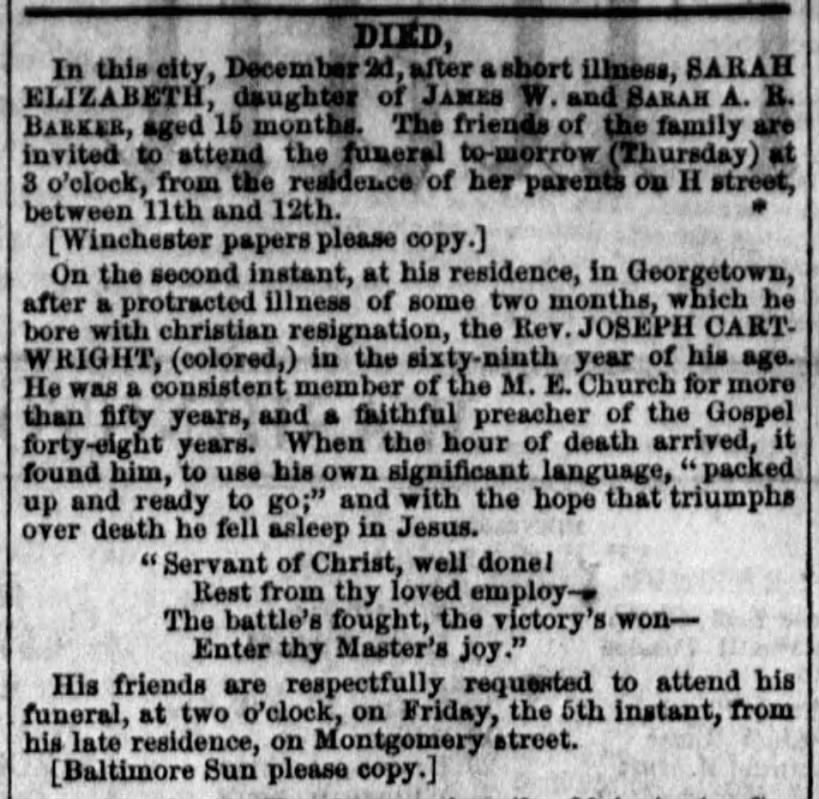
Daily American Telegraph (Washington, D.C.), December 3, 1851, p. 2, Newspapers.com.
Path to Freedom
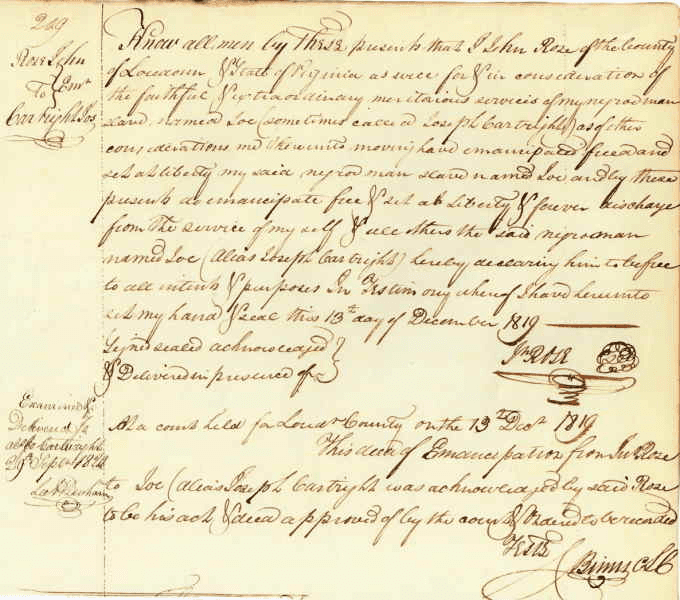
On December 13, 1819, Reverend Cartwright purchased his freedom from a John Rose in Lessburg, Loudoun County, Virginia, with wages earned through a combination of preaching in the local Methodist community, community support, and possibly small payments for his services. After manumission, he dedicated his life to buying the freedom of his wife and children with wages he earned as a travelling preacher. In 1823, he purchased the freedom of his wife, Sussanah (Sucky) Cartwright and his son Alfred Cartwright. Over the next 16 years, he worked as a travelling preacher, raising money to buy the freedom of the rest of his children from different enslavers across Maryland and Virginia. In 1839, he purchased the freedom of his last child, Nora, and manumitted the entire family in that September. Notably, in 1840, he appealed to John Quincy Adams to help free his grandchildren, a meeting Adams recorded in his diary.
Rose, John. Manumission of Reverend Joseph Cartwright Sr. 1819, Loudoun County, Virginia. Manuscript document.
Reverend & Church Work
Reverend Joseph Cartwright began working as a preacher within the local Methodist community while enslaved, as noted in early 1820s Mount Zion church ledgers. In 1824, he began formally working as a preacher at the Ebenezer Methodist Church on Capitol Hill, where became the first Black preacher formally placed on salary by the Methodist Episcopal Church in D.C. Here, he earned $25 per year. In 1825, the Baltimore Conference appointed him as a supply pastor for the Black congregation, and in 1826 he became the first Black ordained elder in the Conference, yet did not have full voting rights. Between 1823 and 1839, Rev. Joseph Cartwright traveled and preached at Black congregations across the northeast as part of the Baltimore Conference.
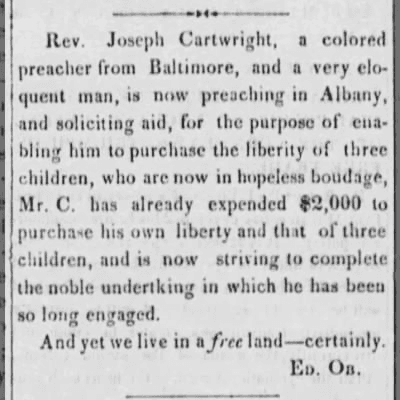
Vermont Religious Observer (Middlebury, Vermont), March 4, 1846, p. 4, Newspapers.com.
This congregation at the Ebenezer Methodist Church on Capitol Hill included Thomas Smallwood, who was enslaved at the time, who later coined the phrase ‘Underground Railroad’ and played a vital role freeing enslaved people through it. Rev. Joseph Cartwright is listed as preaching at the Dumbarton United Methodist Church in the 1848 Quarterly Conference records, but it is unclear when he began preaching there. Unlike those in many areas, enslaved people in Georgetown often had the liberty to attend church and Sabbath School where they could often obtain literacy, and thus Reverend Cartwright served as a preacher for a congregation of both free and enslaved Black members.