Gracey Duckett
Early Life & Family
Grace Ann (Gracie) Duckett was born between 1790 and 1791 in Maryland to unknown parents. Little is known about her early life, and it is almost certain that she was born enslaved to the Eversfield family in Nottingham, Maryland, where she remained enslaved until Charles Eversfield died in 1820. While enslaved by the Eversfields, on April 8 1821, Gracie gave birth to her first child, Emiline Duckett. Gracie was then separated from her sister Nancy Ann Duckett (sometimes listed as Ann Duckett), who continued to be enslaved by the Eversfield family in Prince George’s County until 1836 when she escaped, as evidenced by newspaper advertisements offering $50 for her apprehension. It is unknown what happened to Nancy Ann Duckett after her escape as no records of her have been found after 1836. Gracie was sold to Samuel and Lydia Whitall in between 1820-1822 where she was enslaved in Georgetown until 1862. While enslaved by the Whitalls, Gracie’s children Henry and Julia were born in 1821 and 1824, yet it is unknown who their fathers were (DC History Center MS 0725.1298).
Gracie is first mentioned at the Dumbarton house, which was rented by Samuel Whitall from 1820-1841, in an 1826 loan agreement, where she, her son Henry, and her daughters Julia and Emeline are listed as collateral. In 1824, Charles Eversfield's son, John Thomas, sold Gracie’s daughters Emiline and Julie Ann as term limited indentured servants to the Whittal family, reuniting Gracie with her daughters. Under the terms of this 1824 indenture agreement between John Eversfield and Samuel Whitall, Julie Ann was to be manumitted on October 17, 1838, yet was kept in bondage until July 10, 1841 (age 24), two months after her marriage to Lewis Cartwright. The last mention of Gracie’s other daughter, Emiline Duckett, is in an 1829 mortgage by Samuel Whitall, and it remains unknown what happened to her after this date.
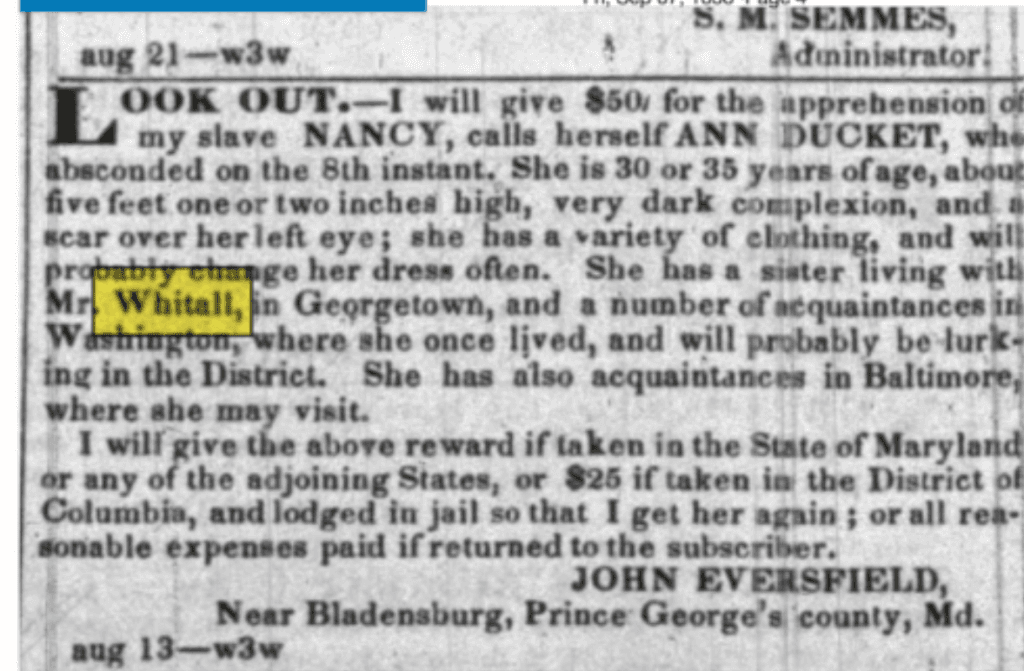
3 September 1838. National Daily Intelligence. Escape of Ann or Nancy Duckett, sister of Gracie
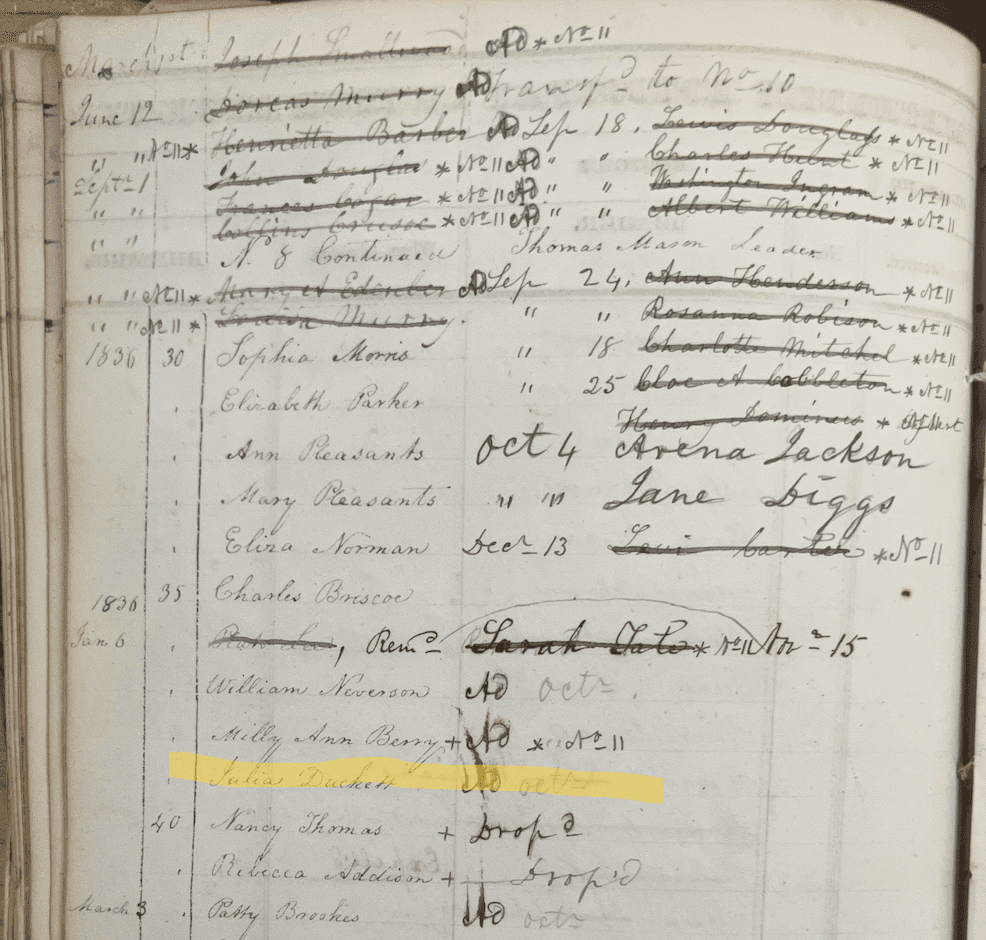
Gracie’s Reality
While enslaved by the Whitall family, Gracie’s reality differed greatly from what she experienced when owned by the Eversfields: urban slavery allowed free and enslaved black populations to be in constant contact, and as such Gracie and her family were amidst a community of both free and enslaved Black people. Gracie and her daughter Julia are listed as members of the Black congregation at the Mt. Zion Methodist Church, where Reverend Joseph Cartwright served as a preacher. Further, records indicate that Gracie’s daughter, Mary Duckett, attended Sabbath School at 15 years old in 1848.
“1863 Register of Mt. Zion Methodist Church,” church record, Mount Zion United Methodist Church, Washington, D.C., 1863.
Journey to Freedom
When Samuel Whittal died in 1855, he left the entirety of his property, including his enslaved laborers, to his wife Lydia Whittal. The 1860 census lists Gracie as a free person residing in Lydia Whitall’s home (pictured), however, this record did not reflect her actual condition; she remained legally enslaved and therefore vulnerable to being sold or displaced at any time. In 1862, Lydia Whittal passed away and manumitted Gracie in her will. Unusually, Lydia left Gracie with a yearly stipend of $30 to be paid out of her own estate until Gracie’s death. As written in her will “I discharge from slavery my servant woman Grace & direct my Executors to pay her out of my Estate the sum of thirty dollars annually during the term of her life, in half yearly payments,”. After manumission, Gracie moved in with her daughter Julia Ann Duckett (who was manumitted in 1841) and her husband Rev. Lewis Cartwright to their Georgetown home, where she resided until her death on July 28, 1874.
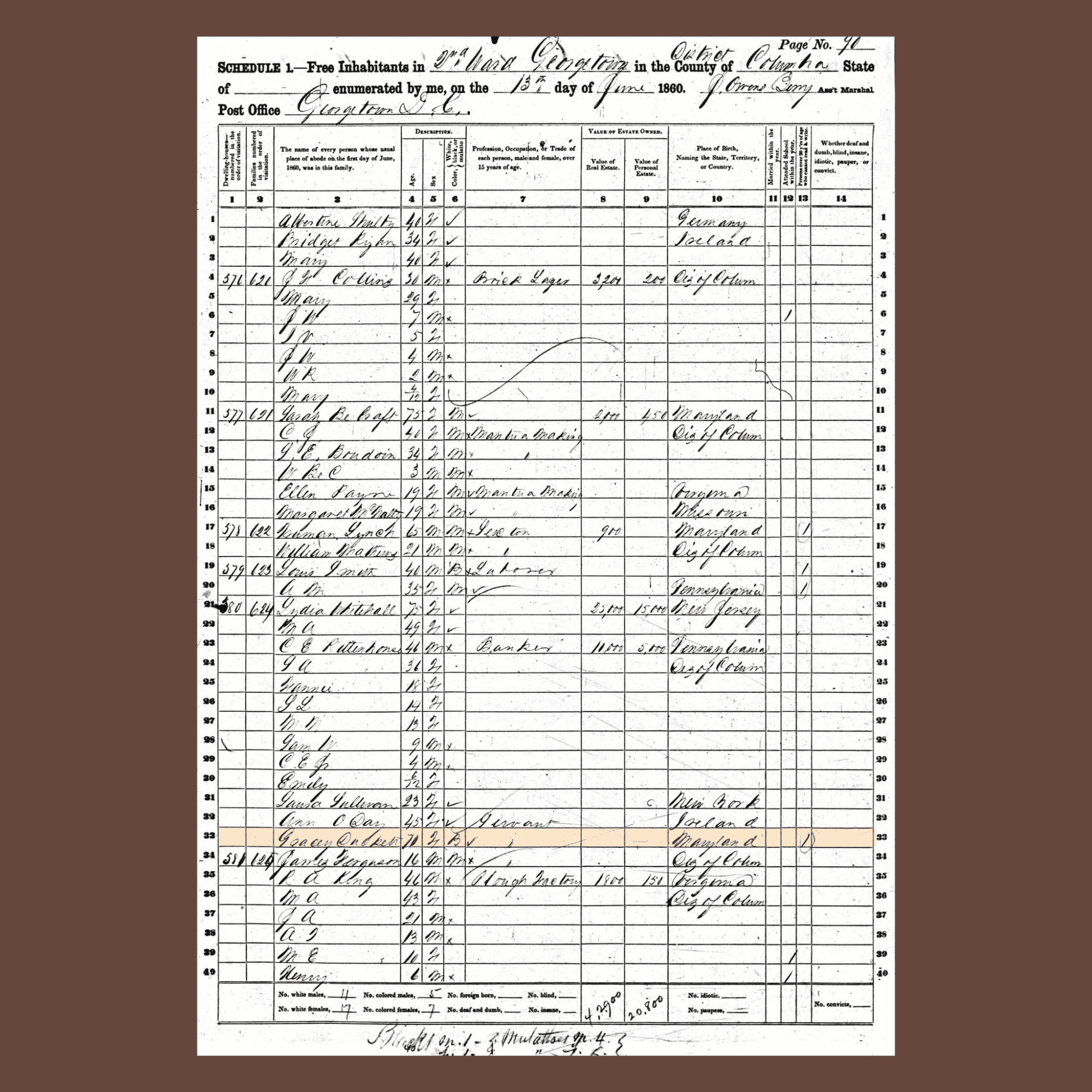
United States Census Bureau. “Schedule I: Free Inhabitants in Georgetown, District of Columbia, 13 June 1860.” 1860 U.S. Federal Census, manuscript page image, National Archives and Records Administration