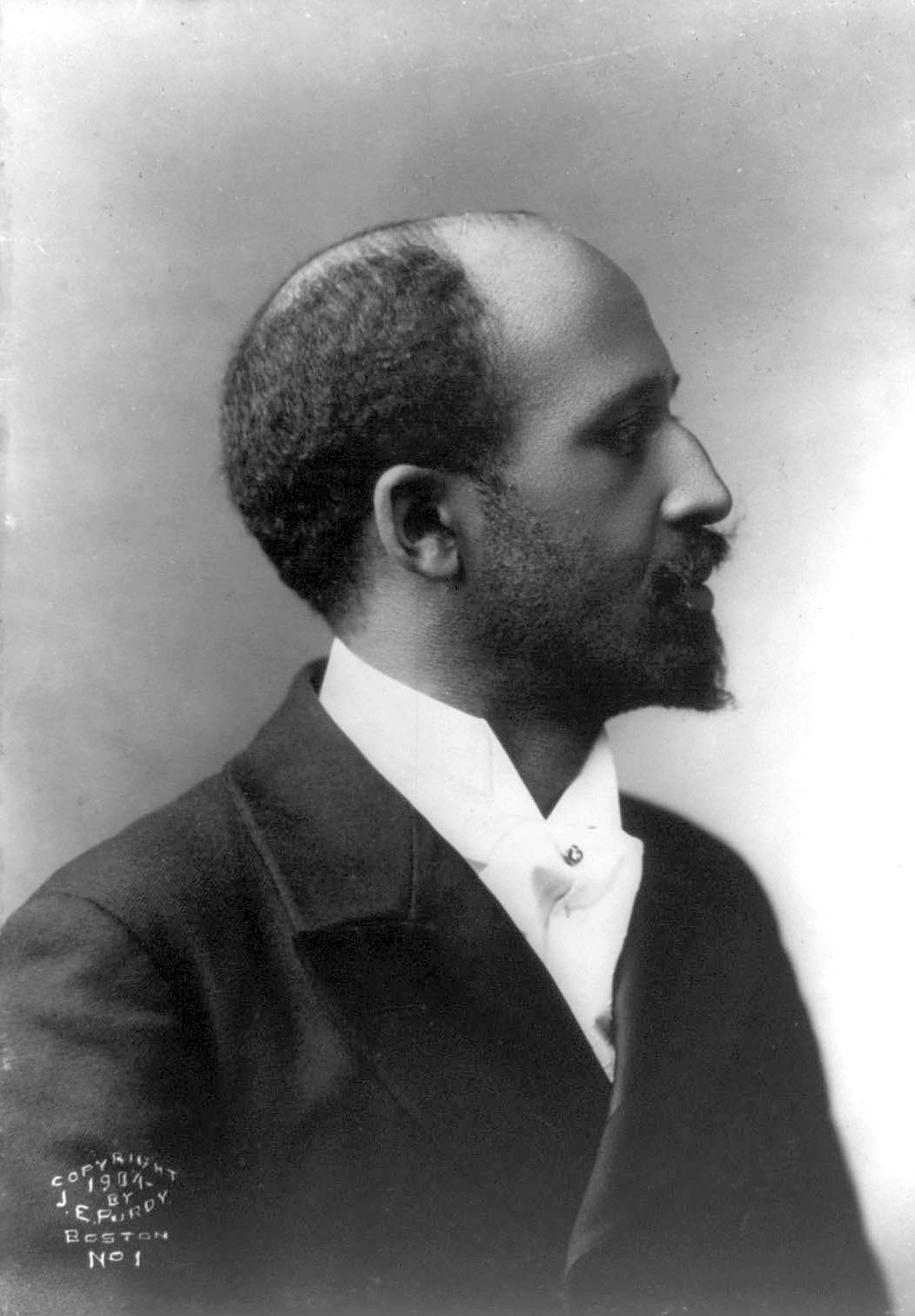
W.E.B. Du Bois
Jack Rohloff
In his “Soul of Black Folks” W.E.B Dubois writes on the experience of being a Black person in America. Throughout the first chapter, he recounts his childhood realization of racial difference, symbolized by a ‘veil’ that separates Black people from white society. This veil creates what DuBois refers to as a ‘double consciousness,’ or the constant awareness of seeing oneself through one’s own eyes, but simultaneously the eyes of a white society that demeans and stereotypes Black people. DuBois explains that this sense of double consciousness creates “two warring ideals” within one person: being both Black and American in a nation that refuses to see those two entities as coexistent. This idea of double consciousness draws an interesting connection to our research on the Cartwright and Duckett Families. Black cemeteries, such as the Mount Zion and Female Band Union Cemeteries, can clearly be understood as sights of double consciousness in DuBois’ sense, as they are part of dominant society, yet distinctly separated.
The physical placement of the Mount Zion and Female Band Union Cemeteries recalls this very idea, as they are distinctly separate from the historically white Oak Hill Cemetery nearby. (Note that there is history of white disinterments from the Mount Zion cemetery after the reaction of Oak Hill (LOC), as it was created many decades later.)Thus, while unified physically with dominant society in death and burial, as the veil descends, it becomes clear that the Mount Zion and Female Band Union Cemeteries are left isolated from the wider continuum. On this, we must still acknowledge the inequalities that non-white communities faced when it came to burial rights even after death; like in the case of the Moses Macedonia African Cemetery and the Westwood Tower apartment complex where “Hundreds of bones found there may be the remains of enslaved people and their descendants, while more bodies may lie under the parking lot of the… complex,” (The Guardian).
"About Donald Winnicott," Top Banner, winnicott-trust.org.uk/wp-content/uploads/2024/02/Winnicott-trust-page-banner-about.jpg, The Winnicott Trust.
The headstones that sparked our research also embody this very sense of twoness or double consciousness that DuBois writes of as they reveal how Black lives were simultaneously visible and obscured: visible enough to be marked in stone, yet still constrained by strict racial orders that defined their external identities. The very existence of these headstones declares a sense of dignity, memory, and selfhood, which reflects how the Cartwrights, Ducketts, and the Black community saw themselves and their family members. Yet, the physical state of these headstones, segregated from white burial areas and some moved around and damaged, could mirror how white society might have perceived them. In this sense, these headstones can act as material expressions of double consciousness: they can preserve an inner story of Black humanity, personhood, and community pride while simultaneously reflecting the external community that diminished, misclassified, and marginalized that same humanity. Thus, the headstones can be seen to illustrate how members of the Black community in Georgetown were forced to navigate this sense of twoness—their own understanding of their worth and humanity and the distorted reflection imposed by white society, even in death.
by James E. Purdy; United States Library of Congress